My name is Faye Doyle and to tell you the truth, I personally chose this particular module based on the fact that it involved a trip to Amsterdam. Since I would admit that I am someone who loves to travel and so far I have visited Amsterdam 4 times, soon to be 5, yet this trip will be a lot different to my past trips to the city; as the purpose for all my past holidays to the “dam” have been motivated by the festival or music event taking place at that time. So in that instance, I am looking forward to having a different approach to visiting the place, which I hope and believe I will get a more in-depth observation of the busy City, as I want to take on the role of an observer rather than a tourist. Also I expect to be more questionable about the culture this time round, as well as expecting to notice and acknowledge aspects of the City I hadn’t the previous times I have been.
This is the first post on my new blog. I have started this blog in order to trace the steps of my research right from the get go. I think that by doing this, I will be able to look back on my thinking and planning and therefore get a clearer vision on how my research came about in the first place.
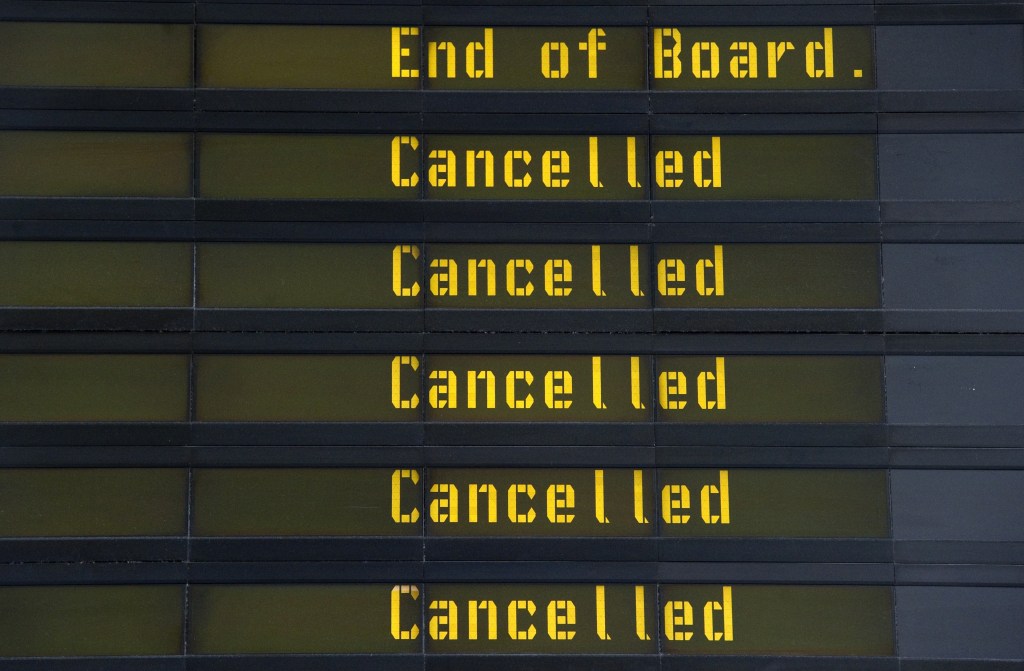
What is happening? – “Europe, like the rest of the world, is facing an unprecedented public health crisis, quickly spreading across the continent. News channels report regular updates on the number of people who are affected and lost their lives” And so European and national authorities have been having to implement drastic measures to limit and slow down the spread of Covid-19; in effort to keep populations safe and healthy. This includes restrictions on “travelling, commuting and social gatherings” in which are to no surprise severely impacting several key economic sectors. “Many flights are cancelled, and schools, restaurants and borders are closing. The term ‘lock-down’ captures the new reality in many European countries.”( https://www.eea.europa.eu/articles/reflecting-on-climate-neutrality-ambitions ) This is so out of the ordinary for everyone, our lives have been put on hold and this expresses the seriousness of Covid-19 as a serious public health crisis. In reflection to our research topic, the cancelling of flights and the limiting of travel, puts into perspective how much people rely on travel everyday. What’s more, is that during lock-down, jobs associated with travel such as taxi drivers, bus drivers, train drivers, have all been labelled as “key workers” whereby they are essential workers in need of still functioning to allow other key workers such as NHS staff and supermarket staff and more, to travel to their workplace.For example I work in a supermarket and so I am still expected to work but without transport systems I couldn’t, as to get to work I travel via bus or taxi and the other day I had a conversation with my taxi driver about them being still running as normal as I was apprehensive about whether they still would be, in which he said that his duty is to get essential workers to work and without people like him and other workers in travel, a lot of people would be without transport and therefore those people would have no choice but to not go to work; in which this really opened up my eyes to how important travel is for both everyday and uncertain/ desperate times like this.
Thoughts on the governments actions – The Covid-19 crisis has uncovered what governments are capable of doing, Marmot points out that austerity has been a choice by the government, as for the government’s change of heart, as spending suddenly becomes available in context of the Coronavirus. Plus, Marmot says that the urgent response of the government to this emergency being swift and decisive, has been far from alike to the reaction to the climate crisis; as it has been a “slow-burn” issue and that the “Coronavirus exposes that we can do things differently,” Marmot said. “We must not go back to the status quo ante.” ( https://www.google.co.uk/amp/s/amp.theguardian.com/world/2020/mar/28/coronavirus-tackle-climate-crisis-and-poverty-with-zeal-of-covid-19-fight-scientists-urge )
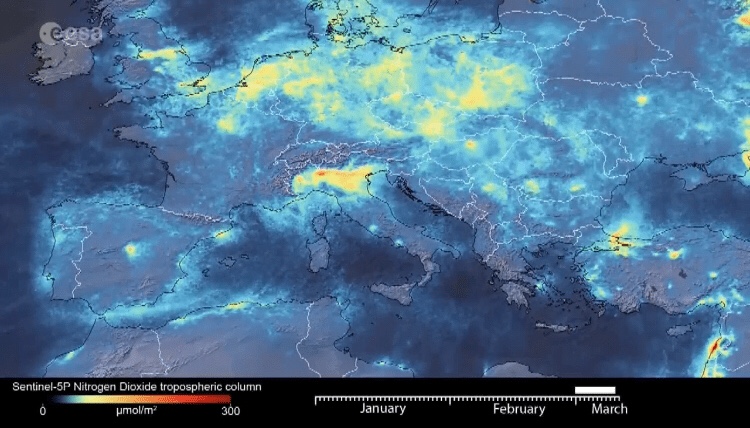
An article by Adam Vaughn, points out that the quarter of the global population on Coronavirus lock down, means that there is a lack of cars and planes and as a result air pollution is expected to have dropped. ( https://www.newscientist.com/article/2239152-covid-19-has-caused-a-drop-in-emissions-but-its-not-a-climate-fix/ ) Having read this, It has led me to think about how we didn’t catch our flight to Amsterdam and how I was frustrated and disappointed, however I now understand that this decision has in fact contributed to our subject matter of environmental sustainability, as well as realising how lucky we are for not going as it might of meant us being in lock-down in Amsterdam, instead of safe at home with our families.
It has been recognised that the response to the current crisis has reduced emissions and air pollution but this i son the short term for sure.Hickel, stated that “When you scale down energy use and industrial production, it does have these ecological benefits but the crucial thing to observe is that this is happening in an unplanned, chaotic way which is hurting people’s lives,” and that “We would never advocate such a thing. What we need is a planned approach to reducing unnecessary industrial activity that has no connection to human welfare and that disproportionately benefits already wealthy people as opposed to ordinary people. There are much more equitable, just and carefully planned ways to approach this kind of problem.”( https://www.google.co.uk/amp/s/amp.theguardian.com/world/2020/mar/28/coronavirus-tackle-climate-crisis-and-poverty-with-zeal-of-covid-19-fight-scientists-urge ) So besides the positive reductions, we need to remember that the response implemented is having a negative effect on the population, everyone is facing very unusual circumstances and quite frankly everyone is feeling worried sick.
Plus, “without a fundamental transformation of our production and consumption systems, any emission reduction triggered by such economic crises is likely to be short-lived and come at an extremely high cost to society.” Also, “Europe aims to achieve climate neutrality through gradual and irreversible emission reductions and by setting long-term objectives to build a resilient economy and a resilient society.” So even with results in significant temporary reductions in emissions, Covid-19 will not in any way be perceived as an event with positive outcomes, as for its harsh impacts it has had on society. Yes, serious changes in our systems of production and consumption need to be carried out, but not like this; shutting down our society will never be an acceptable solution to urgent and systemic sustainability challenges. ( https://www.eea.europa.eu/articles/reflecting-on-climate-neutrality-ambitions )
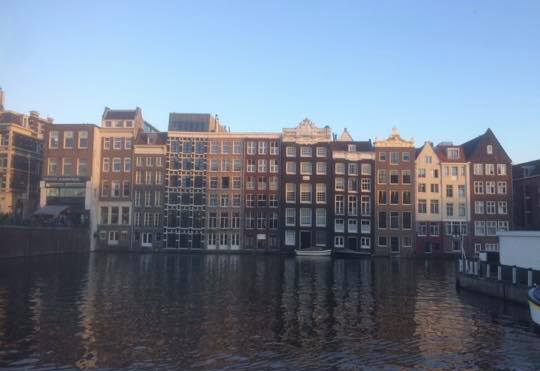
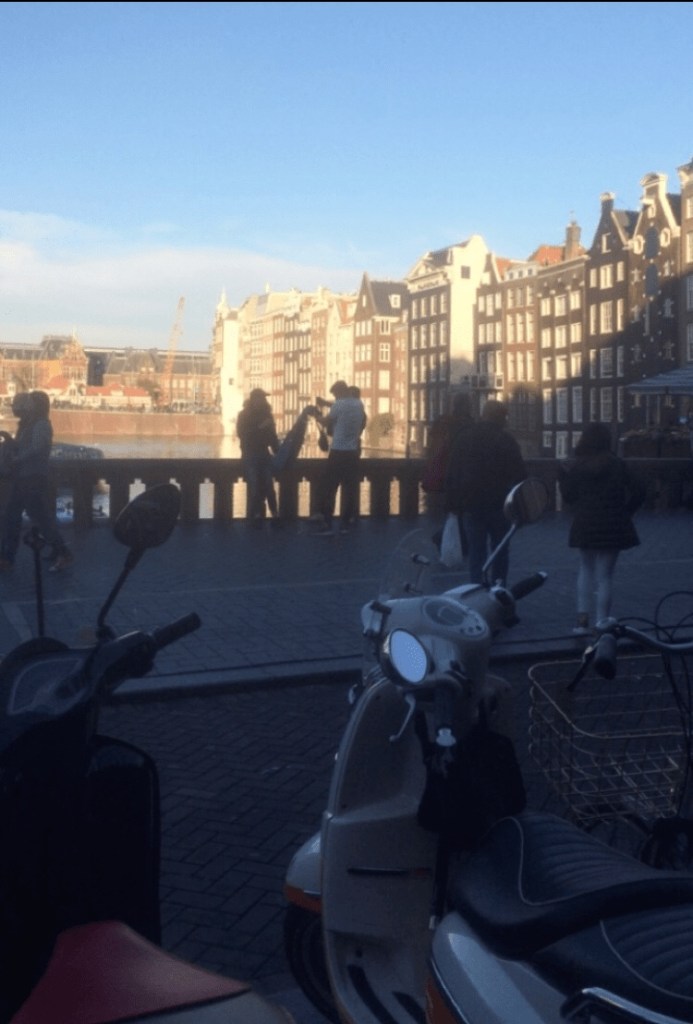
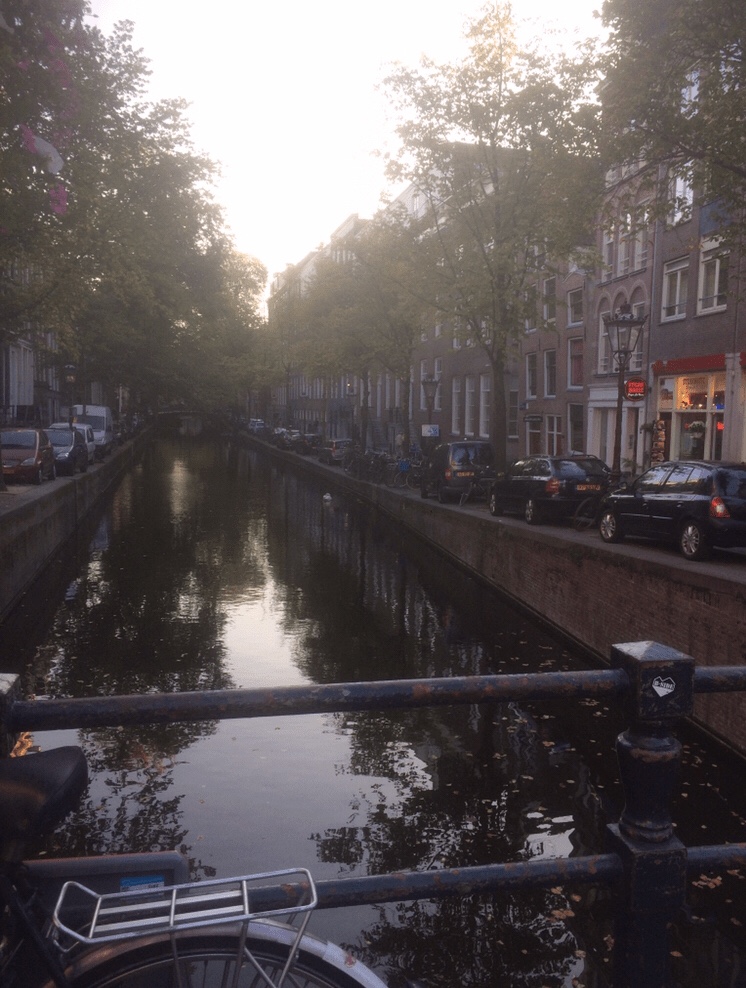
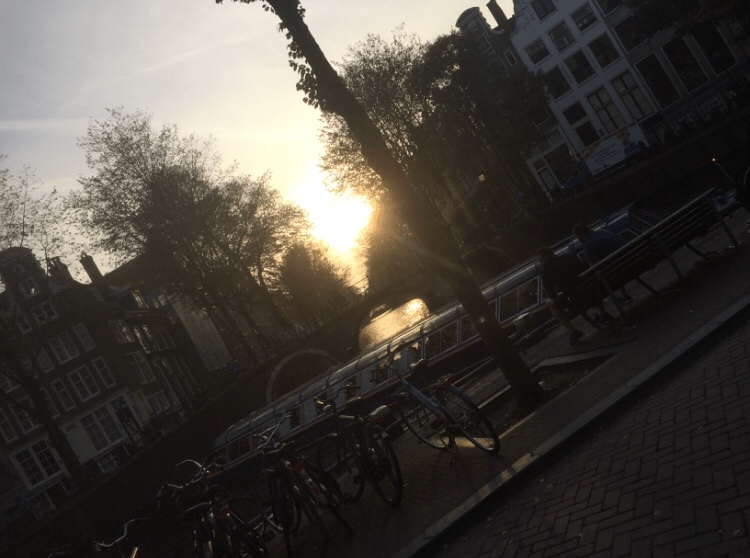
(A scooter and a walk path visible)(A bicycle seat visible in the left/bottom corner and cars parked on either side of the canal)(A row of bicycles parked up on the left and a ferry in the canal)
Interestingly, all of these images I have taken in the city in past years, show a form of transport within them.
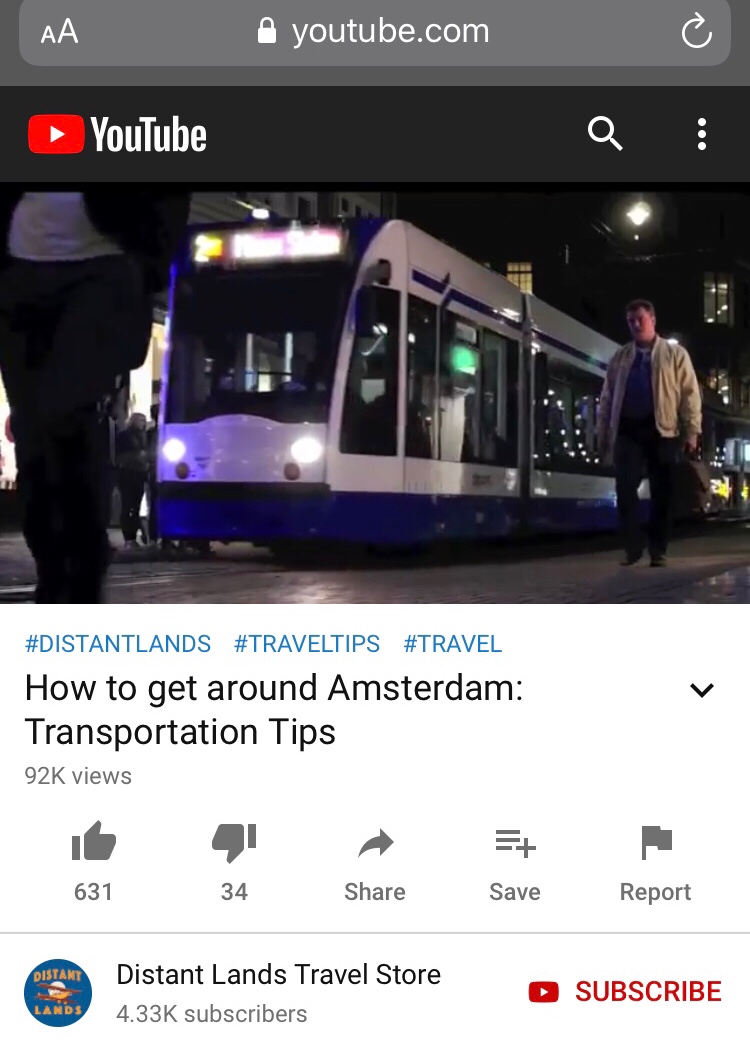
What the video says about the transport in Amsterdam-
Travel in Amsterdam can be straightforward and convenient if you know what you are doing and complete confusion if you don’t.
The extensive network of transport is operated by the GVB, it connects the City’s neighbourhoods by Tram, metro, bus and ferry. There are also trains, cars and bicycles that help round out the possibilities.
The easiest way to break down your transportation options, are as follows-
Trains are for going to the airport, other cities or to other countries.
The metro is for getting in and out of the city to the suburbs.
Canal boats are for sightseeing routes such as hop on and hop off tours.
Renting a car is for the ambitious, it is difficult to get around and driving is a hassle and parking quickly becomes a nightmare.
Trams and buses are the easiest and most inexpensive from anyone to get from point A to point B within central Amsterdam.
Bicycles rule Amsterdam and the best way to get around, there are separate bicycle lanes throughout the city making it safer and very convenient to get across the city very quickly. Also you can easily rent a bicycle for a few hours for a couple of days.
Public transportation in Amsterdam operates from 6am until midnight.
The public transportation OV-chipkaart is the way to pay for public travel in Amsterdam and for short trips to Amsterdam, the OV-chipkaart is advised and you can purchase this at the ticket counter at central station, ticket machines at stations, newsagents, supermarkets and with tram and bus drivers. They have a check in and check out system for the use of this.
The reason behind me looking at this video, is that it allows me to observe all the forms of transport me and my group had planned to use on our trip, except this way was a lot quicker and less time consuming, although we have of course missed out on the personal experience and feelings that would of come with doing it firsthand (but this cant be helped). Our group has agreed that each of us will pick a separate YouTube video on “transportation guidelines/tips in Amsterdam” , to then write a blog post about what the video tells us and this way we can gain a more wide ranging understanding on the transport, plus we can compare the findings to see if there is a shared opinion on the transport systems or if the advice differs.
We have had to adjust our observation aspect of the research, from primary data collected by ourselves on the field trip to instead secondary data collection through already existing videos. We have chosen Youtube video’s as a source of data due to the fact that we had planned to make a Youtube video ourselves to represent the observation material we would of captured during our time in Amsterdam.
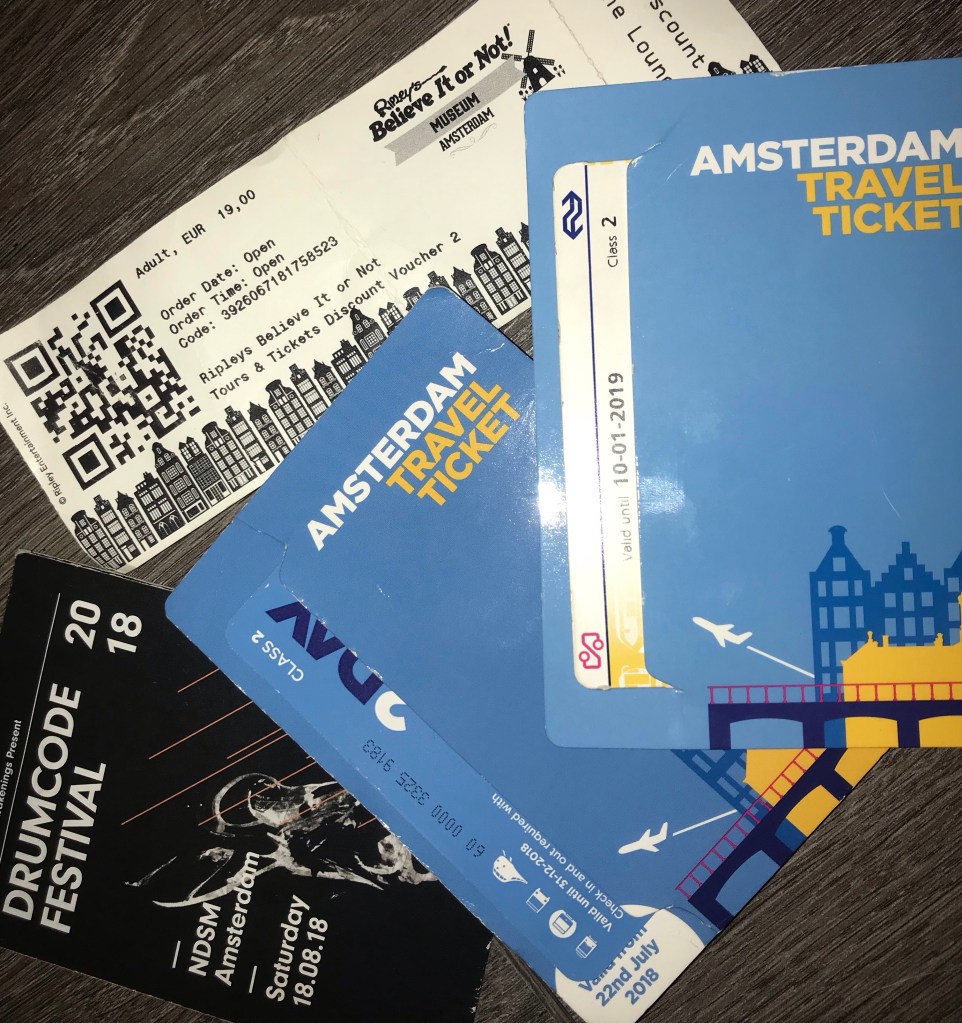
So I found a few things that I had kept from my past trips to Amsterdam. A ripleys believe it or not museum ticket, A drumcode festival map of the NDSM docks where the festival occurred and 2 GVB travel tickets, one from 2018 and the other from 2019. I like to keep little things like this as memorabilia’s, that represent my time in Amsterdam. Which means that I must of thought of them to be representative of my experience in Amsterdam; with the travel tickets suggesting that travel was a particularly big aspect of my time there and I can say that this definitely was the case, as travel is a main factor of your typical day in the city of Amsterdam.
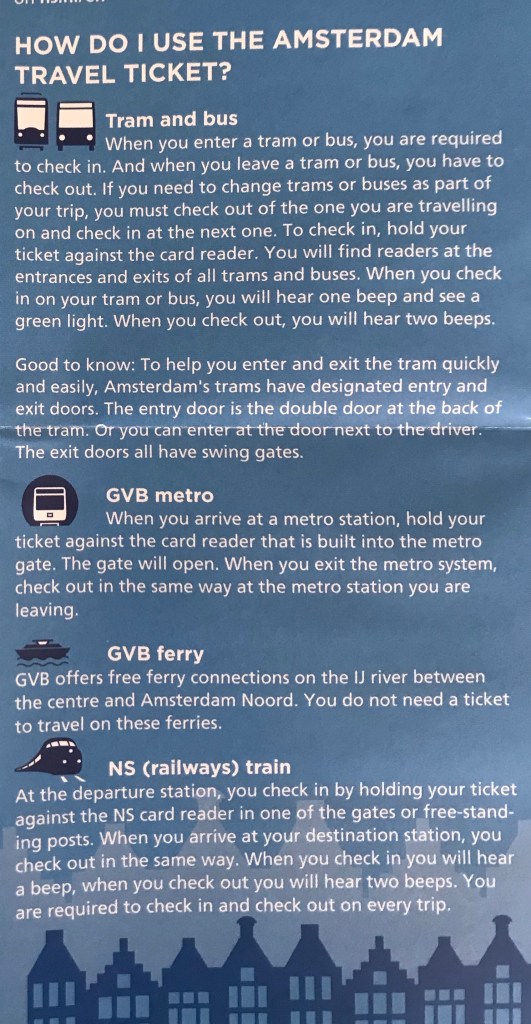
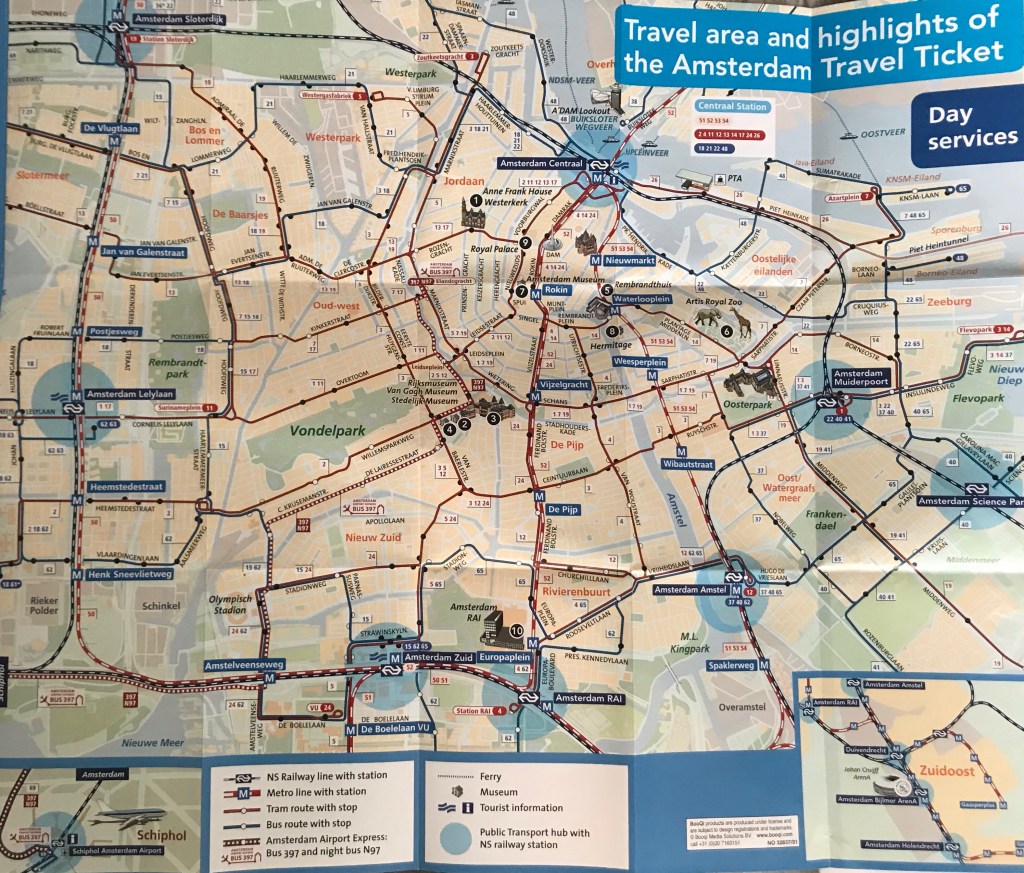
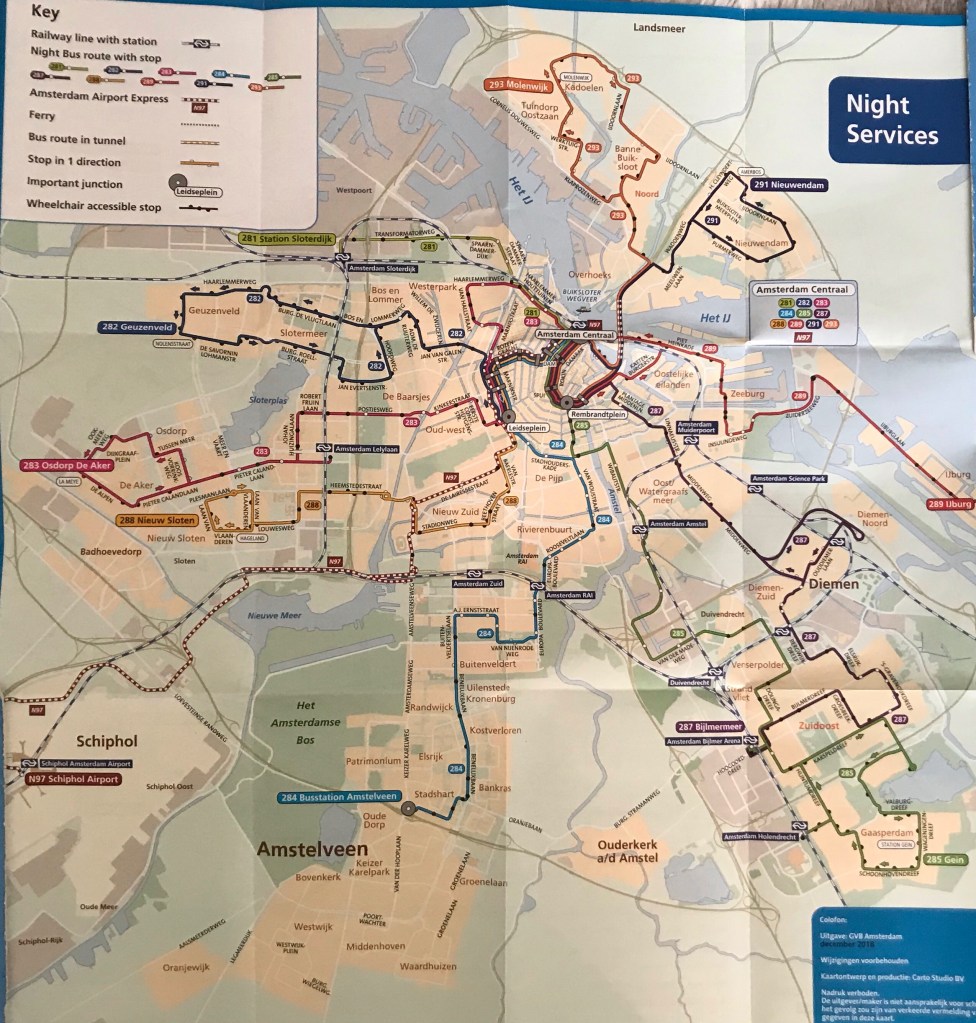
Each and every time I have visited the City of Amsterdam, the first thing I have done once reaching the destination, is buy a 3 day travel ticket in Schiphol Airport railway station and this ticket by GVB allows you to travel by bus, tram, metro, train and ferry.
(This info is in the booklet that you receive when you buy the 3 day long ticket)
This is the day service map on one of the sides of the booklet –
This is the night service on the other side-
When in Amsterdam I have only used the train, bus, tram and taxi. From the beginning of every visit to Amsterdam, I have used the train from the get go, since as soon as you land in the airport, the easiest way of getting to the centre/hotel is by using the train station in the airport, also in the past the train is the best way for getting in and out of the city; usually when I have stayed in a hotel outside of the centre. I use the bus and tram to get around the city centre despite the destination being walking distance I have found that it is much quicker, to use the transport, so of course it makes sense to use the transport instead of walking having already paid what I remember as €24 to get the transport ticket. Plus, when thinking back to the city centre, you are constantly surrounded by bus and tram stops, with maps and information inside that clearly tell you what route to take and what number bus/tram operates in that direction, making it very handy and accessible to use the public transport around you. Throughout my previous trips to Amsterdam, I have used taxi/Uber when needing to go a far distance away from the city centre, this tends to be only when I have attended a festival and wish to get there quicker than the tram/bus and perhaps it is because I have always thought a taxi/Uber to be more reliable in getting me to the festival in time; without having to worry or stress about getting to the right place without the risk of getting on the wrong bus/tram (yet this transport option is not covered by the transport ticket, which means excess money being spent).
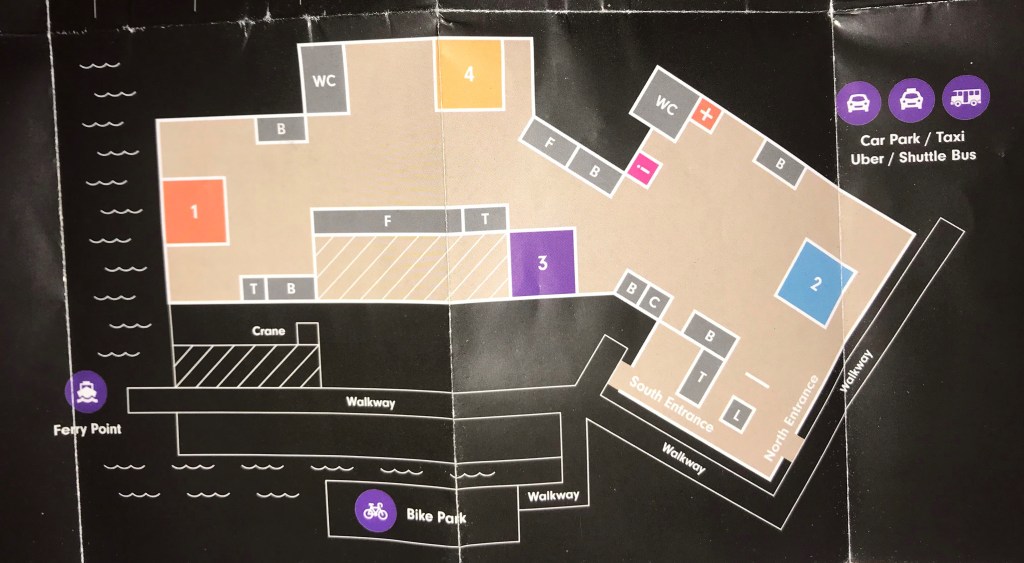
A festival I have most recently been to in Amsterdam is “Drumcode festival” in 2018, which was held on the NDSM docks.
Map of the festival
This map shows that transport is very much incorporated within a successful event; well thought out in order for the festival to run smoothly. The map has a check point for ferry travel, a car park for taxi/Uber, shuttle bus access and a bike park; this tells me that the transport options on the map are the most popular for people in Amsterdam? Maybe that’s why the festival has ensured them to be available? Also this makes me think that travel is a way of supporting a big crowd of people, to assist them in getting to and from the festival (to allow the festival to be of reach to all people no matter the distance). So this makes the target audience a diverse one and without all these forms of travel, those people attending would be limited, to if they could get there or not. Overall,the different travel systems work together to make it possible for people of different places to unite.
We are now unable to have face-to-face contact with each other, which means that we are forced to come up with alternative ways to discuss our plans. Sara, has introduced a live chat link which allows us all as a module group to share concerns and solutions. We have been keeping each other up to date with what position we are in with our research, via the live chat and a Facebook messenger group chat.
As for our research group, we have kept in contact through a snapchat group chat, in which we have discussed our research plans, as well as informed one another if any of our contacts have responded after requesting to interview them; which then we conduct a reply back, together as a group (to ensure that nothing is left out and everyone has a chance to input their say).
After this announcement was released, we as a group decided that we still want to research sustainability in Amsterdam but through Virtual research methods; this means that our research objective is to stay the same but the means of how we achieve it changes. We have agreed that we are going to …
Interview 2 people we know have been to Amsterdam recently (no longer than 2 years ago) so that their experience of the city is up-to-date.
Observe 3 YouTube videos that demonstrate the transport we aimed to observe ourselves; then compare the videos and what each one says ( similarities + differences?)
We are having to rearrange our research plans to suit the new circumstances, but the original research methods for our data collection was semi-structured interviews, observations and urban tours.
The two transport companies we had hoped to interview were GVB and RAi, in which we have previously contacted regarding a meet up. RAÍ has not been responsive and as for GBV, they answered with the following message: “Thanks for contacting us. Unfortunately, we are really busy with our concession and our strategies. However, I would like to help you with your research, can you share your questions here with us and we will try our best to help you as best as possible. Via the following page, you can find already some information regarding our sustainability plans: https://over.gvb.nl” . Which means that despite the field trip being cancelled, it has not effected the process in which we would have gained insight from this company. Also, we had expected to interview residents of Amsterdam through the “We Live Here” organisation to understand what transport they use on a daily basis, yet we will have to get in touch and see if an interview by other means is possible.We had also looked for potential Coffee shops who specialised in being sustainable in aim to interview the owner or a worker. Through Facebook we searched and found the business “Back to Black” ( https://m.facebook.com/backtoblackcoffee/ ). We then messaged them via fb messenger asking if they were available for an interview in the time we would be in Amsterdam, since a post on their home page revealed that one of their key values was “to work as sustainable as possible”, however they haven’t yet got back to us. Also, whilst browsing through Facebook we came across an organisation named “Sustainable Amsterdam” in which led us to their website ( http://sustainableamsterdam.com/ ) the organisation provided a lot of information significant to our research topic, so we messaged the organisation via fb messenger, also asking them if a member would be happy to partake in an interview, however they too failed to contact us back. This means that unfortunately, so far we only have one possible participant willing to be involved with our research.
As for changing our interview plans, perhaps we will contact those that didn’t respond with the proposal of doing an email interview, phone-based interview or a Skype conversation, to see whether this might alter their decision, as the time frame is made more lenient. As well, it might be beneficial for us to contact different businesses in case that our low response rate stays the same.
As for the observation side of our research, we had thought of documenting and capturing the reality of the transport in Amsterdam by using a go-pro. Then with the images and videos we would had collected we might have made a short video displaying the experiences within the trip, very much provided a visual insight of our findings, plus it would of shown sustainable transport in action rather than just in writing.
But instead, we may have to be creative in thinking of other ways to observe the transport in Amsterdam without actually being there in person. One thought, is that we could use secondary data, such as already existing YouTube videos that show Amsterdams transport through other people’s experiences and too we could compare the videos out there to see if there are any similarities and differences, moreover we could monitor if sustainability is regarded throughout their travelling choices or whether it is other factors that make up their mind in how to travel. By searching transport in Amsterdam on youtube, a selection of different videos are recommended, with those being “travel transport guidelines” and “travel tips” ( https://m.youtube.com/results?search_query=transport+in+amsterdam ) and with the wide range of videos available, I scrolled through and found that, all the types of transport we had hoped to experience, are all recorded on film (bus, tram, train, ferry, bicycle); this will for sure be very helpful in enlightening us on Amsterdams travel systems, as well as at the same time becoming aware of many other people’s opinions. Moreover, we could use our own past experiences to Amsterdam, as I have personally been 4 times, which means that I have experienced the transport systems on several different occasions, therefore I have primarily built up an opinion on the types of transport I have used there, plus I can consider what aspects are the most memorable from my previous trips. Having said this, I have actually found a travel guide from the GVB transport company; which I kept as a keepsake, suggesting that I would have believed it to be a reminder of my experience; which shows that transport was featured within my impression of the City.
An additional method we had chose to utilise was urban tours, however there was a consistent pattern and that was the prices of the tours, with almost all of them being expensive, usually costing between £40-£75 each, so we decided to ask for an interview with someone from the Lonely Planet Experiences: In the City of Bikes tour ( https://www.urbanadventures.com/Amsterdam-tour-in-the-city-of-bikes ) ,as for their eco-friendly approach, but unfortunately we didn’t get a response. What’s more, is that we had organised to do a walking tour with PIC, which means that we will be missing out on the valuable information and feelings that would of been provided and generated doing this. We may have to see if there are any substitute tours in Liverpool which will explore similar themes.
At this moment of time, I feel as if our research is all up in the air, having only one source of data (GVB) being responsive and I’m worried that this will go against us in the long run and when coming to doing our final report. I think that our group now needs to meet up and solidify a more up to date plan on how to progress towards our research objectives, despite the obstacles getting in our way. I view Mondays lecture (16th of March) as an important opportunity to do exactly this, as it will set us up with a plan for the week, as well as coming to terms with virtual fieldwork and what it entails. More so, it will help us to get our heads around the changes and hopefully restore confidence in what our intentions are.
This image expresses my mind set at this moment of time (to try and stay focused and positive)
So, this morning the university notified us that the plans to go to Amsterdam aren’t able to go ahead due to the CoVid-19 virus. This news has been unanticipated and very unfortunate, as I was looking forward to getting there and getting started, I feel as if we have been landed in a fairly sticky situation, as if we have to go back to the drawing board and start all over again. But, there may be a chance that we don’t have to completely start all over again, as for the city of Liverpool conveniently being on our doorstep, especially at this time of need for a similar environment to gain research experience. We must come to terms with the fact that Liverpool is as close as we are getting to Amsterdam, so now we must think of ways to convey any possible links, in effort to re-enact similar research aims and to of course continue exploring our chosen topic. Plus, virtual fieldwork has been mentioned as a possible alternative and although it will not be the same as we hoped for, it will however allow us to use the contacts we had already developed beforehand; you never know we might find that virtual fieldwork could be more popular as some may suspect an email interview, phone-based interview, Skype conversation or e-information exchanges as less pressuring as it is in their own time, also they should not be conscious of the time taken to answer the questions; which might mean their answers being well thought out and more detailed as for them having the time to think rather than having to answer there and then.
It looks as if our first plan of action will be informing our contacts, to update them on the most recent circumstances and to consider what alternative ways we can achieve our research aims.
In today’s lecture we began with the challenge to utilise any knowledge we had on filming, in attempt to produce a well presented interview clip, taking in turns being the interviewee and interviewee (somewhat a trial and error for when the time comes for doing the real thing in Amsterdam). Our group was straightaway familiar with the need to have the participant as the main focus in the video and to ensure that there was good lighting and that the setting of the environment looked natural and not too staged or forced; plus we thought that filming the interview on the side rather than straight on, made the interview more natural (with the interviewee looking in the direction of the interviewer rather than the camera). However, after looking back at our interview video, it was recognised that there was a bottle in the corner of the video on the table, which turned out to be distracting, also the participant felt that the angle was unflattering, which shows that it is important to check the angle with the participant perhaps before filming or by filming a few seconds and showing it back to them to make them feel as comfortable as possible. What’s more, is that the bottle being a distraction led us to think about the usage of significant props in the video, such as if there was a logo on a bottle that linked to who and why we were interviewing that person, it would add to the image and purpose of the interview, or perhaps having a background with relevant posters for example. What have I taken from today’s trial run? – it has most definitely allowed us to be conscious of not repeating the same mistakes, as well I have gained further insight and awareness on what steps to run through before filming, meaning that I will be more confident in putting it into practise. Also, we came to the decision that we would not film an interview, as we felt that it was overall intimidating and adds unnecessary pressure to the interviewee, having experienced being the participant ourselves it helped us come to terms with what makes a participant more comfortable and willing to engage. But we did agree that filming for the visual side of our research, was a great way to capture the full experience of the transport in Amsterdam, plus the idea of combining short clips to make a 1 or 2 minute video, showing the forms of transport side by side, was spoke about in today’s lecture and I believe that this would be a great way of recording and demonstrating what we observe.
So when looking back at our completed proposal, I felt that we did the following things to advantage our proposal- LITERATURE…I THOUGHT we had a vast range of literature, including articles with a broader outlook on the topic of sustainability in Amsterdam, literature based on research in the field of transport and sustainability accompanied with statistics that demonstrated the findings (allowing ourselves to estimate and hold expectations to what we might discover in our own research) , then we incorporated literature which observed the impacts the matter has on society. The FEEDBACK given about the literature section, was to think about how the issues recognised will be intertwined in our research questions and that our blogs should be referenced within and not in appendix, but overall it was noticed that we had a good mix of articles. METHODS… I THOUGHT that we had referred to relevant literature on methodology and explained what our plans and intentions are when conducting our chosen methods. The FEEDBACK was that we needed the methods to be more detailed and more about Who, how and where will the method be used. In the section of WHO WE WANT TO INTERVIEW AND WHY, the FEEDBACK was that we needed to be more specific about who we hope to interview such as providing contact details and in depth description, plus it was recommended that we are not to just interview a tourist but to instead consider who might be more successful in answering our research questions, offering the thought that we might be better off “asking cafe owners and businesses the pros and cons of the transport systems that are in place and how this impacts on them” which made a lot of sense as surely this participant type will be easier to find and contact beforehand to organise an interview, compared to arriving at Amsterdam to search for someone we can’t exactly easily distinguish from the rest of the people in Amsterdam. The FEEDBACK told us that we need our EXAMPLE RESEARCH QUESTIONS to be to ask the appropriate questions to the right people, with the public being to ask them what transport they use, why and how sustainability is important to them, plus it was mentioned that the order of our questions could be improved, since some of our questions near the end of the interview are “general warm up questions” and should be asked at the beginning. The ETHICS part of the proposal had FEEDBACK explaining that it lacked literature and needed to be more in depth and cross referencing to the ethics form and PI form in appendices to show evidence that we have done what we say we have done. Overall the proposal was marked as 60%. I will no doubt take this feedback seriously in order to ensure that our research plan is altered and improved, so that it is carried out successfully and to its full potential.
As a group we have decided that semi-structured interviews would be suitable in researching the senior management side of the transport systems we will be looking at, as we aim to go into the interviews with a set of questions related to the the topic of sustainability and hope that by asking specific questions it will set the theme and we hope that it will then stem other equivalent discussions. We also agreed that carrying out observation methods will be of use to our research topic, by using visual tools to display an accurate representation of the transport used in the City of Amsterdam. What’s more is that we hope to put observation methods into practice when personally experiencing the different types of transport the city has to offer. The target participants we plan to research are both the locals and the tourists of the city and we expect to perhaps find a difference in the transport utilised by each of them.
 Faye's International Fieldwork Blog