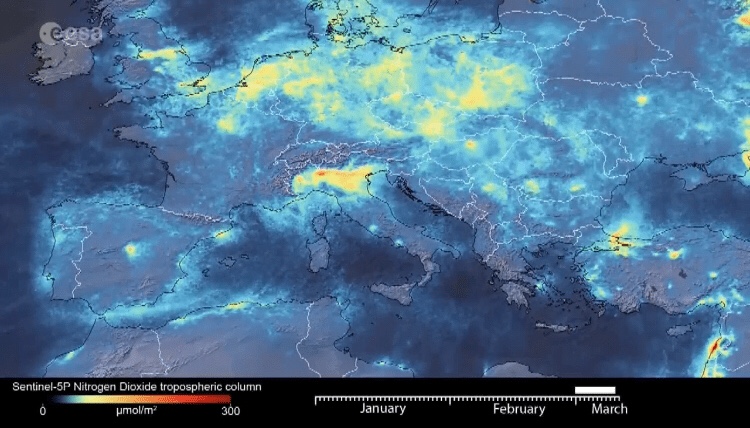
What is happening? – “Europe, like the rest of the world, is facing an unprecedented public health crisis, quickly spreading across the continent. News channels report regular updates on the number of people who are affected and lost their lives” And so European and national authorities have been having to implement drastic measures to limit and slow down the spread of Covid-19; in effort to keep populations safe and healthy. This includes restrictions on “travelling, commuting and social gatherings” in which are to no surprise severely impacting several key economic sectors. “Many flights are cancelled, and schools, restaurants and borders are closing. The term ‘lock-down’ captures the new reality in many European countries.”( https://www.eea.europa.eu/articles/reflecting-on-climate-neutrality-ambitions ) This is so out of the ordinary for everyone, our lives have been put on hold and this expresses the seriousness of Covid-19 as a serious public health crisis. In reflection to our research topic, the cancelling of flights and the limiting of travel, puts into perspective how much people rely on travel everyday. What’s more, is that during lock-down, jobs associated with travel such as taxi drivers, bus drivers, train drivers, have all been labelled as “key workers” whereby they are essential workers in need of still functioning to allow other key workers such as NHS staff and supermarket staff and more, to travel to their workplace.For example I work in a supermarket and so I am still expected to work but without transport systems I couldn’t, as to get to work I travel via bus or taxi and the other day I had a conversation with my taxi driver about them being still running as normal as I was apprehensive about whether they still would be, in which he said that his duty is to get essential workers to work and without people like him and other workers in travel, a lot of people would be without transport and therefore those people would have no choice but to not go to work; in which this really opened up my eyes to how important travel is for both everyday and uncertain/ desperate times like this.
Thoughts on the governments actions – The Covid-19 crisis has uncovered what governments are capable of doing, Marmot points out that austerity has been a choice by the government, as for the government’s change of heart, as spending suddenly becomes available in context of the Coronavirus. Plus, Marmot says that the urgent response of the government to this emergency being swift and decisive, has been far from alike to the reaction to the climate crisis; as it has been a “slow-burn” issue and that the “Coronavirus exposes that we can do things differently,” Marmot said. “We must not go back to the status quo ante.” ( https://www.google.co.uk/amp/s/amp.theguardian.com/world/2020/mar/28/coronavirus-tackle-climate-crisis-and-poverty-with-zeal-of-covid-19-fight-scientists-urge )
An article by Adam Vaughn, points out that the quarter of the global population on Coronavirus lock down, means that there is a lack of cars and planes and as a result air pollution is expected to have dropped. ( https://www.newscientist.com/article/2239152-covid-19-has-caused-a-drop-in-emissions-but-its-not-a-climate-fix/ ) Having read this, It has led me to think about how we didn’t catch our flight to Amsterdam and how I was frustrated and disappointed, however I now understand that this decision has in fact contributed to our subject matter of environmental sustainability, as well as realising how lucky we are for not going as it might of meant us being in lock-down in Amsterdam, instead of safe at home with our families.
It has been recognised that the response to the current crisis has reduced emissions and air pollution but this i son the short term for sure.Hickel, stated that “When you scale down energy use and industrial production, it does have these ecological benefits but the crucial thing to observe is that this is happening in an unplanned, chaotic way which is hurting people’s lives,” and that “We would never advocate such a thing. What we need is a planned approach to reducing unnecessary industrial activity that has no connection to human welfare and that disproportionately benefits already wealthy people as opposed to ordinary people. There are much more equitable, just and carefully planned ways to approach this kind of problem.”( https://www.google.co.uk/amp/s/amp.theguardian.com/world/2020/mar/28/coronavirus-tackle-climate-crisis-and-poverty-with-zeal-of-covid-19-fight-scientists-urge ) So besides the positive reductions, we need to remember that the response implemented is having a negative effect on the population, everyone is facing very unusual circumstances and quite frankly everyone is feeling worried sick.
Plus, “without a fundamental transformation of our production and consumption systems, any emission reduction triggered by such economic crises is likely to be short-lived and come at an extremely high cost to society.” Also, “Europe aims to achieve climate neutrality through gradual and irreversible emission reductions and by setting long-term objectives to build a resilient economy and a resilient society.” So even with results in significant temporary reductions in emissions, Covid-19 will not in any way be perceived as an event with positive outcomes, as for its harsh impacts it has had on society. Yes, serious changes in our systems of production and consumption need to be carried out, but not like this; shutting down our society will never be an acceptable solution to urgent and systemic sustainability challenges. ( https://www.eea.europa.eu/articles/reflecting-on-climate-neutrality-ambitions )
 Faye's International Fieldwork Blog